Trandox Transport Systems
NEXUS ADI™ powers decision integrity across Trandox’s transportation, carrier, and partner visibility systems; improving shipment coordination and reducing escalation events across global logistics networks.
Case Studies > Supply Chain & Logistics > Trandox Transport Systems
Company Overview
Case Study
Global Transportation Visibility & Coordination
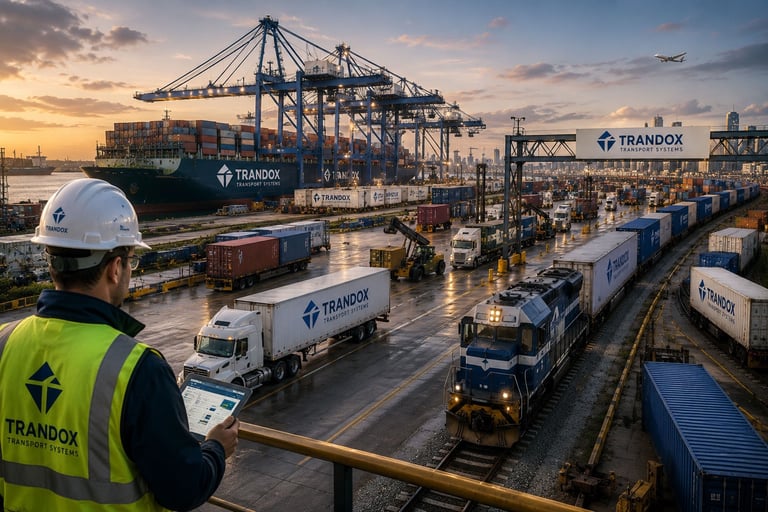
Trandox Transport Systems** is a global transportation organization coordinating shipment visibility, carrier performance, customer delivery commitments, and partner logistics networks across multiple regions.
The company manages complex transportation workflows involving carrier status updates, shipment milestones, customer notifications, exception handling, and partner system integrations.
As transportation networks expanded, maintaining consistent visibility across internal systems, external carrier platforms, and partner APIs became increasingly difficult.
While individual systems provided useful shipment data, operational conflicts emerged when status signals, exception alerts, and delivery commitments did not remain synchronized across the broader transportation ecosystem.






Operational Challenge
Trandox experienced increasing complexity as shipment volumes, carrier relationships, partner integrations, and customer visibility expectations expanded.
Operations teams observed recurring situations where carrier updates, shipment status, OMS commitments, and customer-facing visibility data became misaligned.
While each platform produced accurate information independently, escalation conflicts appeared when shipment decisions depended on inconsistent signals across systems.


Cross-System Shipment Visibility
Improved shipment visibility coordination, escalation accuracy, and synchronization reliability across carrier, transportation, and partner systems.
Business Impact
Increased manual investigation of shipment exceptions
Inconsistent visibility across carrier and partner systems
Higher escalation volume from conflicting shipment status data
Reduced confidence in automated customer notifications
Difficulty scaling transportation visibility across global operations








Solution: NEXUS ADI Implementation


Results
Systems Integrated




Trandox implemented NEXUS ADI™ as a decision integrity layer across its transportation visibility ecosystem.
Rather than replacing existing transportation or visibility platforms, NEXUS ADI™ operated across participating systems to evaluate shipment decisions before operational actions occurred.
Carrier updates, shipment milestones, OMS commitments, partner signals, and exception rules were validated for consistency before triggering downstream workflows.


Transportation visibility problems were not caused by a lack of shipment data.
They emerged when carrier, partner, and internal systems produced fragmented signals that became inconsistent during execution.
NEXUS ADI™ improved logistics reliability by validating shipment decisions before they triggered customer, carrier, or operational impact.
Key Insights


Global transportation networks depend on coordination across internal systems, external carriers, partner platforms, and customer-facing visibility tools.
As visibility ecosystems become more automated, the challenge shifts from collecting shipment data to ensuring that data produces reliable, consistent, and executable decisions.
By establishing a decision integrity layer, Trandox improved visibility reliability, reduced escalation volume, and strengthened transportation execution across its global logistics network.
Business Interpretation
Executive Perspective
Our challenge wasn’t generating more recommendations. We already had intelligent systems. The opportunity was ensuring every decision stayed aligned across inventory, fulfillment, and customer commitments before execution.


Carlos Mendoza
Chief Transportation Officer
Trandox Transport Systems


After NEXUS ADI
Before NEXUS ADI
Shipment visibility varied across systems
Carrier updates required manual validation
Customer-facing status occasionally conflicted with operational reality
Escalations were triggered from incomplete or inconsistent signals
Teams spent time reconciling shipment status across platforms
Improved shipment visibility consistency
Reduced manual escalation events
More reliable carrier and partner coordination
Greater confidence in automated customer updates
Better alignment between transportation execution and customer commitments
Scalable global visibility operations
What Changed
Explore more Case Studies
Healthcare | Retail eCommerce | Manufacturing

© 2026 H9AI, LLC. All rights reserved.
All trademarks, service marks, trade names, and logos referenced herein are the property of their respective owners. References to such marks are for identification purposes only and do not imply any affiliation with or endorsement by the respective owners. Illustrative case study. Company profiles and quotes are fictional; scenarios and outcomes reflect representative enterprise implementations and NEXUS ADI™ capabilities.
NEXUS ADI™ an H9AI, LLC Company